
Most people know Nanjing as the site of the Japanese invasion during World War II and subsequent Nanking Massacre. But few realize that Nanjing, an eastern Chinese city of 8 million located along the Yangtze River, is today angling to be known as "the famous software city of China" - to quote promotional materials from the Nanjing Municipal People's Government. Granted, a lot of Chinese cities from Shenyang to Hangzhou are vying to become hubs for information technology, particularly cities like Nanjing and Shenyang that have long had industrial economies.
I recently had the opportunity to to make my own assessment of Nanjing's prospects as a Silicon Valley. Invited to join a delegation of business executives and investors traveling from the U.S. to check out the city's high-tech ecosystem, I spent several days in this historic city that has served as the capital of China through several periods, including when the Republic of China was founded in 1912 by Sun Yat-sen and later, in 1927, under Chiang Kai-shek and the Kuomintang.

I toured the Sun Yat-sen Mausoleum, climbing endless steps to reach its perch on Purple Mountain above a vast forested park. And I peeked in rooms of the Presidential Palace, situated downtown near an ultra-modern building that houses the city's library.

But most of the time in the city was spent exploring the Nanjing High-Tech Zone, which was established just 10 years ago, and a newly opened biomedical business development center there. See photo taken at the opening ceremony, held in the ballroom of the five-star Jin Ling luxury hotel, where we listened to a translated Chinese speech by Zhao Xiaojang, Nanjing's deputy mayor. At a Chinese luncheon banquet to celebrate the opening, seemingly endless
ganbei toasts were made by party officials, high-tech execs and the visiting delegation - which by the way included some who's who firms in U.S. investment banking leagues. A charm offensive meant to facilitate more such exchanges was launched by both sides, with individuals circling around the tables, saying they are all friends and downing the potent Chinese liquor
baijiu in one shot to show they meant it. One stand-out example of grace under pressure - particularly for a first-timer to China - came from New York businessman James Gomez who spoke of "cooperation for common benefit" and praised one party secretary in attendance for "great vision."
While most of the delegation was jet-lagged, having arrived on a flight from New York City the night before, we trudged off in the afternoon to tour the still-unoccupied offices of new anchor tenant - NJ Pharma Tech Corp. of Raritan, N.J. CEO Chuck Zhu showed us around. He told of the reasons why he decided to base his operation there, key among them the abundance of talent from 48 universities and colleges in Nanjing, including three even within the 82 square kilometer zone, to staff his budding operation. He has the company of 200 enterprises, including 50 high-tech outfits, that have already set up here. Indeed, the high-tech park is a miniature city with its own international school, two hospitals, three supermarkets, banks, a golf club, hotel resort, villas, gardens - and what else could you want (though Nanjing is known as one of the three furnace cities of China for its soaring summer temperatures). The high-tech park is so new that freshly planted trees look more like shrubs. While impressive compared to many such zones in the Valley, I must admit that it pales next to the mammoth software parks I've visited on the Pudong side of Shanghai. The Nanjing park could use better rail transport links to the city, which are coming by 2015, and some in the delegation pointed out the tech zone, at 50 kilometers from the airport and separated by bridges from the main part of the city, could be more convenient too.
That said, the highlights of the tour was yet to come. And one has to keep in mind that Silicon Valley took some 20 years to develop, while China has only begun to tap into this high-tech arena for economic development.
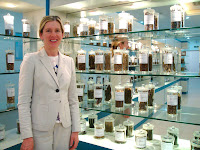

Back to the tour, we got a glance at the research center of a facility that is seeking to standardize the process of using herbs in traditional Chinese medicine. See photos. The brains behind this operation is Zisheng Xu, a PhD in pharmaceutical sciences from Osaka University of Japan, who has just moved here from a research post at a Hong Kong university. Ok, it may not be a San Diego or Singapore Biopolis yet!
At what's called the Transportation Industry Park - one of three key areas of the zone - our delegation hopped on golf carts and proceeded through a sparkling clean plant that has the capacity to churn out 200,000 spiffy MG sedans. Yes, the Chinese have bought the assets of the former British automaker, though "Charles," the deputy general manager of the operation, tells me that the cars are still designed by engineers in the U.K. The cars cost $30,000 and 10,000 were sold last year in China. I'm pictured with a few classic MGs that the operation now owns.

What's more, we got a pitch about the Enterprise Park, one more element to fertilize entrepreneurship here. With funding from four governmental bodies, this initiative offers an attractive incentives package of tax holidays, free office space and free residential housing for overseas students returning home to establish a base here. More than 100 students have taken up the offer and founded 50 research enterprises here.
That night for dinner we feasted at a banquet with yet more toasts at the Pearl Spring Hotel, overlooking a tranquil lake that we could see from our picture windows. As 9pm neared, we called it a day and our delegation headed by police-escorted bus back to the Jin Ling Hotel, ready for a good night's rest.

Not finished yet! On the Sunday morning of the Dragon Boat weekend holiday in China, we listened to a speech by Zhu Shanlu, a "Standing Member of Jiangsu Provincial CPC Committee and "Secretary of Nanjing Municipal CPC Committee." His talked was peppered with phrases that were translated like this: "We appreciate that you have shown confidence in our cooperation." At a luncheon where I was seated close to the provincial party leader, I had the opportunity to 'gift' a copy of my book to him. Through a translator, we exchanged a few words. He likes my
Silicon Dragon book title and said it reminded him that he wants Nanjing to be known as "Life Science Valley." Sounds like good branding to me, I said. It's connections like these that may have led to my sudden VIP-like treatment on my Air China flight back to the U.S. One has to wonder.

 The first, photographed here, is Jeffrey Chen, CEO of NeoPac Lighting. My driver had a tough time finding the firm, on a side street of Chubei City near Hsinchu Science Park--Taiwan's equivalent to Silicon Valley. But once there, I was treated to a bright display of the firm's LED lights, which shine for up to 50,000 hours with less power. By the way, Chen has a wall of patents in his office to show for his work.
  In fact, in the early years of 1980s, Taiwan had intentionally copied the Silicon Valley tech model but had trouble attracting firms. It wasn't until 1989, Dr. Yen said, that the government adopted a policy to foster the development of the so-called integrated circuit business. Once the PC took off soon thereafter, the foundries ramped up quickly. Now that sales are slowing with the financial crisis, the science park is developing a biomedical campus, just a 15-minute drive away on the other side of the river. Right now, these companies generate less than 1 percent of the park's revenues, but Dr. Yen predicts it has "great potential to grow," developing new drugs and medical devices.
  Well, Doan tells me he immigrated to the states in 1975 from Vietnam to earn an enginneering degree from UC-Santa Barbara and work at a series of tech firms in the U.S. and Europe, and eventually settled in Boise, working at Micron (which got its start thanks to Simplot). Doan said he chose Taiwan to base his current operation because of the goodies that were offered--no tax for the first five years, and great infrastructure at the Hsinchu Science Park. So far, so good. The company is selling 5 million units per month and chalked up revenues of $16 million last year with a team of 230 people.


